

About the LHCs
Historical Context
The James Bay and Northern Québec Agreement (JBNQA), signed in 1975, was the first modern Aboriginal treaty in Canada, a landmark agreement between the Cree and Inuit peoples of Québec and the provincial and federal governments. It addressed land rights, resource development, and social and cultural issues, while establishing key institutions for Inuit governance, education, and health. Over time, the JBNQA has been modified by more than 20 complementary agreements, expanding its provisions and refining its implementation.
For Nunavik Inuit, the JBNQA introduced a new land regime that divided traditional territory into three categories. Category I lands, allocated for the exclusive use of Inuit beneficiaries, became the foundation for creating Inuit Landholding Corporations (LHCs), which manage these lands today. Category II lands were reserved for exclusive Inuit hunting, fishing, and trapping rights, while Category III lands remained under general provincial jurisdiction with certain Inuit rights preserved.

Land Selection Process
Following the signing of the JBNQA, Inuit communities faced the complex task of selecting their Category I and II lands, a process that lasted from 1975 to 1980. Community Land Selection Committees, composed of hunters and elders, worked closely with negotiators to map traditional land use and propose selections. Initial proposals prioritized river corridors, coastal areas, and regions rich in wildlife and resources, but Quebec imposed new criteria to consolidate selections and minimize their “visual impact” on provincial maps.
Despite these challenges and limited resources, Inuit leaders ensured fairness: each community received roughly 243 square miles of Category I land, while Category II allocations combined a base amount with adjustments for population size. The process concluded in 1980 with Complementary Agreement No. 6, formally integrating the selections into the JBNQA. In the years that followed, Quebec surveyed Category I lands and finalized maps, which were approved and signed by the newly established Landholding Corporations in 1986.
These corporations remain central to Inuit governance and stewardship, safeguarding lands that are vital for culture, subsistence, and community development.
Timeline of Key Historical Events
-
Quebec Superior Court injunction halts James Bay hydro project, triggering negotiations.
-
JBNQA signed; initial Category I and II land selections presented.
-
Community ratification meetings held across Nunavik.
-
Category II land selections agreed to in principle after intense negotiations.
-
Complementary Agreement No. 6 signed, finalizing land selections.
-
Survey plans and maps approved and signed by Landholding Corporations.
Nunavik Land Regime
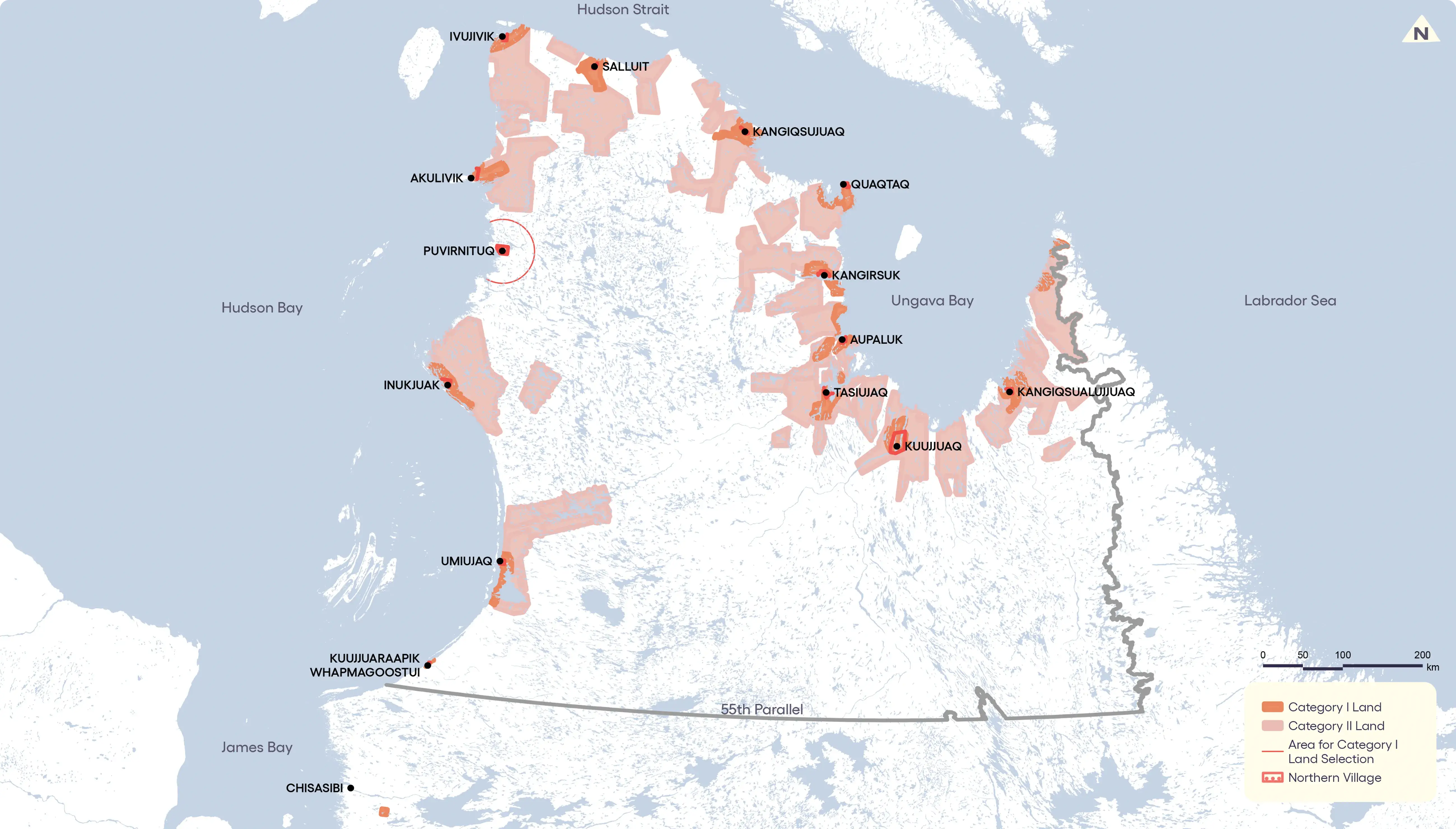
The Nunavik region spans 413,592 km² north of the 55th parallel in Québec. It is home to 14 communities, with a combined population of approximately 14,000 residents. The territory is organized into three land categories, each subject to different rights of ownership and use.
Category I Lands
Category I lands cover a total of 8,159 km² and are owned by their respective Landholding Corporations (LHCs), which are responsible for managing these lands for the benefit of their communities. These lands cannot be sold, seized, transferred, or otherwise relinquished except to the Québec Government. LHCs have the authority to grant leases, servitudes, usufructuary rights, and other rights of use and occupation to individuals or organizations on these lands.
While LHCs hold ownership over their Category I lands, this ownership is limited to the surface, with the exception of soapstone deposits. Subsurface and mineral rights remain under the ownership of the Québec Government; however, the government cannot extract minerals without the authorization of the local LHC and must provide compensation for the use of the land.
Category II Lands
Category II lands total 84,631 km². Category II lands are owned by the Québec Government. The LHCs have exclusive rights to establish and operate outfitting facilities and commercial fisheries. Inuit JBNQA beneficiaries also have exclusive hunting, fishing and trapping rights on Category II lands
Category III Lands
Category III lands encompass all lands in Nunavik that are not Category I or Category II lands. Category III lands are owned by the Québec Government. Category III lands are a joint-use area for Inuit and non-Inuit in matters of access, as well as for hunting, fishing and trapping activities.
| Community | Land Categories (km²) | |||
|---|---|---|---|---|
| Cat I | Cat I Special | Cat II | ||
| Inukjuak | ||||
| Umiujaq | ||||
| Kuujjuaraapik | ||||
| Kangirsuk | ||||
| Chisasibi | ||||
| Aupaluk | ||||
| Quaqtaq | ||||
| Ivujivik | ||||
| Killiniq | ||||
| Kangiqsujuaq | ||||
| Salluit | ||||
| Kangiqsualujjuaq | ||||
| Tasiujaq | ||||
| Kuujjuaq | ||||
| Akulivik | ||||
The Landholding Corporations
Inuit Landholding Corporations (LHCs) were established in 1978 as non-profit organizations under Section 5 of the Act respecting the land regime in the James Bay and New Québec territories (CQLR, c. R-13.1). They were created to hold title to and manage Category I lands and to oversee certain management responsibilities related to activities on Category II lands. They manage activities such as leasing land, approving development projects, and ensuring that land use aligns with community priorities and cultural values.
- Anniturvik Landholding Corporation of Umiujaq
- Arqivik Landholding Corporation of Tasiujaq
- Epigituk Landholding Corporation of Killiniq
- Kigaluk Landholding Corporation of Chisasibi
- Nayumivik Landholding Corporation of Kuujjuaq
- Nunaturlik Landholding Corporation of Kangiqsujuaq
- Nunavik Landholding Corporation of Aupaluk
- Nuvummi Landholding Corporation of Ivujivik
- Pituvik Landholding Corporation of Inukjuak
- Qaqqalik Landholding Corporation of Salluit
- Qekeirriaq Landholding Corporation of Akulivik
- Qiniqtiq Landholding Corporation of Kangiqsualujjuaq
- Sakkuq Landholding Corporation of Kuujjuaraapik
- Saputik Landholding Corporation of Kangirsuk
- Tuvaaluk Landholding Corporation of Quaqtaq
Unlike the other Inuit communities of Nunavik, Puvirnituq did not sign the James Bay and JBNQA in 1975 and therefore did not select any Category I lands under the agreement. As a result, the community does not have a Landholding Corporation.
Membership of the LHCs is composed of Inuit beneficiaries affiliated with their respective communities. As such, LHCs are ethnic-based organizations that serve the interests of their communities while managing Category I lands for the benefit of their constituents.
LHCs key responsibilities include land administration, sports hunting and fishing authorization for non-Inuit, JBNQA beneficiary enrolment and economic development.
Land Administration
Landholding Corporations hold ownership of Category I lands, including any areas located within municipal boundaries. They have the authority to allocate parcels of land through leases or other occupation permits to individuals, corporations, organizations, or government agencies seeking authorization to use the land. Certain parcels are reserved for community services and are provided at a nominal fee of $1. LHCs also receive compensation for the use of mineral rights on Category I lands, such as gravel pits and quarries. Consequently, no development or activity can take place on Category I lands without the proper authorization from the local LHC, ensuring land is developed and used in accordance with community priorities.
Hunting and Fishing
Inuit JBNQA beneficiaries have the exclusive right to hunt, fish, and harvest on Category I and II lands. Landholding Corporations regulate the sport hunting and fishing of non-beneficiaries by issuing permits and setting fees and catch limits for these activities. In addition, they authorize the operation of outfitting facilities and oversee commercial hunting and fishing activities, ensuring that all uses respect local regulations and support sustainable management of the land and its resources.

Eligibility and Enrolment of JBNQA Beneficiaries
Each Landholding Corporation is responsible for managing the enrolment of JBNQA beneficiaries within its community through its local Enrolment Committee. These committees review applications for beneficiary status based on established eligibility criteria and ensure that community records remain accurate and up to date. The committee is composed of the LHC Board of Directors and an Elder, whose presence helps uphold community knowledge and values in the decision-making process. LHCs also collaborate closely with the Nunavik Enrolment Registrar to maintain the official list of JBNQA beneficiaries.
Community Economic Development
Over the years, LHCs have created subsidiaries to help sustain their mission in the absence of core funding. Typically, the LHC is the sole or majority shareholder, and through these companies, they are able to carry out commercial activities that align with their mandate. Today, these subsidiaries play a key role in Nunavik’s social and economic landscape, generating opportunities and supporting local development in sectors such as real estate, hospitality, heavy-machinery rental and construction, as well as renewable energy. By combining business activity with community-focused goals, LHCs contribute directly to the well-being and prosperity of their communities.